Aboriginal Australian Soldiers in World War 2
Aboriginal and Torres Strait Islander Australians have fought for Australia in every war since Federation in 1901.


Aboriginal and Torres Strait Islander peoples were generally treated with less fairness than other Australians, despite the important support they provided.

The country’s first and only all Indigenous army unit, the Torres Strait Light Infantry Battalion, was formed in 1943 as the Japanese Imperial army menaced Australia’s northern coastline.
Approximately 880 recruits enlisted, from an estimated able-bodied male Indigenous population of 890, across the Torres Strait island chain – an Australian sea territory between the northern tip of the state of Queensland, and southern Papua New Guinea.
Salary
This table shows the average Weekly Wage as at 31 December 1938:

Although Indigenous peoples and Torres Strait Islanders provide important support, they generally receive less fair treatment than other Australians. For example, they were deprived of their rightful wages, which were much lower than non Indigenous workers in the same position.

Under the Empire Air Training Scheme, three Indigenous pilots flew missions across Europe and Asia:
-
Flight Sergeant Leonard (Len) Waters
-
Flight Sergeant Arnold Lockyer
-
Pilot Officer David Paul

Leonard Waters
Flight Sergeant Leonard Waters, Australia’s first and only Aboriginal fighter pilot during World War II, seen here in his Kittyhawk 'Black Magic'.
Waters left school before his 14th birthday to support his family, and he worked as a shearer before volunteering for service in the Royal Australian Air Force (RAAF) in 1942. Desperate for manpower to support the air war in Europe and the Pacific, the RAAF’s rules regarding Indigenous Australian enlistment were far less restrictive than those for the Second Australian Imperial Force.
Waters was initially trained as an aircraft mechanic but dreamed of becoming a pilot. His application was accepted in 1943 and he undertook training across New South Wales before graduating as a pilot in 1944.
Later that year Waters was posted to No. 78 Squadron, which was stationed on the island of Noemfoor off Dutch New Guinea. He flew on more than 90 missions from here over the next year.
Arnold Lockyer
Later that year Waters was posted to No. 78 Squadron, which was stationed on the island of Noemfoor off Dutch New Guinea. He flew on more than 90 missions from here over the next year.
Lockyer joined the Royal Australia Air Force (RAAF) in May 1942. After obtaining the qualification of a mechanical ground worker, he was dispatched to the 17th Maintenance and Repair Unit in Cunderin, Western Australia.
After returning to Australia, Lockyer joined the Royal Air Force's 24th Squadron in Fenton, Northern Territory, where he served as a flight engineer for the B-24 Joint Libertadores crew.
He was further promoted to a flying sergeant and deployed with the squadron to Morotai in the Dutch East Indies. Starting from July 1945, the squadron set off from Barikpapan to bomb Japanese targets in support of the Allied attack on Borneo.


David Paul
Pilot Officer David Paul, a bomber pilot who was shot down over the Aegean Sea in 1943; while still a prisoner of the Germans, he was awarded the Distinguished Flying Cross in 1944. (That same year Sergeant Len Waters became the RAAF’s first Aboriginal fighter pilot and served in the Netherlands East Indies, now Indonesia).
On 4 December 1943, Royal Australian Air Force (RAAF) pilot David Paul set of on what should have been the last reconnaissance mission of his tour of duty with No 454 Squadron. Paul was one of the squadron's original members. He was also one of its most experienced pilots (he logged almost 800 hours flying hours during the war).
Within hours of Paul and his crew leaving the base, their Baltimore Bomber was brought down by a German Messerschmitt fighter. He would spend the rest of the war in a German prisoner of war (POW) camp.
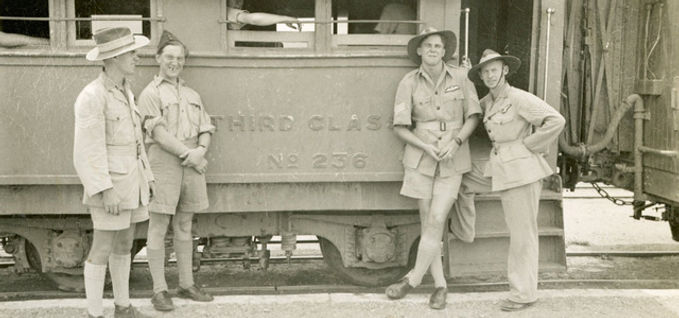
This picture is four guys that graduates of an Empire Air Training Scheme (EATS) course in Rhodesia, and David Paul are one of them.
